


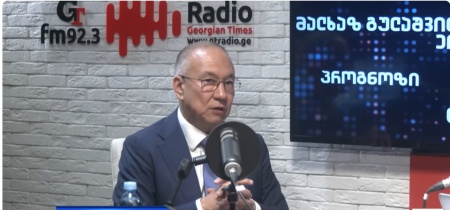
 Interview with the Ambassador of Kazakhstan to Georgia, Malik Murzalin, for the “Real Politics” program of the “Georgian Times” media holding
- Hello and welcome! This is the “Georgian Times” television and radio company, and you're watching “Real Politics.” I'm your host, Malkhaz Gulasvili.
Today we have an interesting guest in our studio—the Ambassador of the Republic of Kazakhstan to Georgia, Mr. Malik Murzalin.
- Good afternoon, Mr. Ambassador. Thank you very much for agreeing to join us today.
- Hello, Mr. Malkhaz. It’s a pleasure to be here, and thank you for inviting me.
- Our interview is taking place shortly after the constitutional referendum held in your country. My first question is: how did the referendum go, and what were the results?
- Indeed, on March 15 of this year, a Republican referendum was conducted in our country on the draft of the new Constitution of the Republic of Kazakhstan.
According to official data from the Central Referendum Commission, more than 9 million citizens of Kazakhstan participated in the referendum, representing over 73% of those eligible to vote. Of those who voted, more than 87% supported the adoption of the new Constitution.
This is evidence of a very high level of unity within Kazakhstan's society and of its support for the policies of the current President, Kassym-Jomart Tokayev.
- And why was it necessary to change the Constitution?
- Now, regarding the necessity for constitutional reform.
The impetus for this initiative was Kassym-Jomart Tokayev's announcement, made on September 8 last year, in his annual Address to the Nation, to move to a unicameral Parliament.
A Constitutional Commission was established, comprising 130 members, including prominent legal experts, heads of media organizations, chairpersons of Maslikhats, representatives of regional public councils, and members of the expert and academic communities. Thus, the Commission brought together representatives of virtually all social groups and regions of Kazakhstan.
While working on the draft of the new Constitution, the Commission members thoroughly examined proposals for the Basic Law submitted by a variety of contributors, including citizens, political parties, civil society organizations, prominent lawyers, human rights activists, public figures, members of parliament, political scientists, and other experts.
As a result, the amendments affected 84% of the text of the country’s Basic Law.
And then the President decided to put the draft of the new Constitution to a Republican referendum.
This is his fundamental position: to put all reforms of vital importance to the country to a national referendum.
- Got it. What innovations in the adopted Constitution would you highlight?
- As I mentioned earlier, the central element of the current constitutional reform is the transformation of the parliamentary system.
The transition to a unicameral parliament known as the “Kurultai”, now supported by the people and elected through a proportional representation system, will make it possible to simplify the structure of the legislative branch while simultaneously strengthening its political role.
Among other innovations, the establishment of the position of Vice President with constitutional status is worth noting. This represents the logical culmination of the political architecture that has gradually taken shape in recent years and is designed to enhance governability and institutional stability.
Overall, the adoption of the new Constitution marks the completion of the process of transforming the institutional foundation of Kazakh statehood and the transition to a completely new constitutional model, in which the emphasis is placed on ensuring a new configuration of power aimed at stability, continuity, and a clearer allocation of responsibilities among the branches of government.
To sum up, I can say that the previous Constitution was adopted more than 30 years ago, during a completely different historical era. Since then, Kazakhstan has come a very long way; the country has changed, society has changed, and people have changed. And it became necessary to amend the country’s Basic Law, according to which society in Kazakhstan lives.
- Mr. Ambassador, you say that Kazakhstan has come a very long way in more than 30 years. Could you tell our TV viewers what modern Kazakhstan is like today?
- Kazakhstan today is a strong, prosperous state that enjoys well-deserved respect throughout the world.
International experts classify our country as one of the so-called “middle powers,” which, thanks to their economic potential, balanced diplomacy, and stable institutions, exert influence and plays a significant role in international relations.
At the end of last year, Kazakhstan’s gross domestic product (GDP) was 306 billion U.S. dollars.
Thus, Kazakhstan has entered the top 50 largest economies in the world, ahead of more than half of the European Union’s member states.
If we calculate gross domestic product based on purchasing power parity (PPP GDP), Kazakhstan ranks 37th out of 196 countries and territories worldwide.
In the Global Competitiveness Index, Kazakhstan ranks 34th.
All of this confirms the country’s growing investment and business appeal.
In the field of diplomacy, Kazakhstan successfully pursues a pragmatic “multi-vector” policy, which has enabled it to build trusting relationships with all the “global centers of power” simultaneously.
- Mr. Ambassador, let’s now talk about Georgian-Kazakh relations. How would you describe the current state of relations between our countries?
- First of all, I would like to note that Kazakhstan and Georgia are linked by traditionally friendly relations, which are developing dynamically on the basis of equality, mutual respect, and mutual benefit.
Regular political dialogue is maintained between our countries.
In February of last year, Georgian Prime Minister Irakli Kobakhidze paid an official visit to Kazakhstan, where he was received by the President and held talks with the Prime Minister.
Our President highly praised the comprehensive development of Kazakh-Georgian relations. In his words, Georgia is a reliable partner of Kazakhstan in the Caucasus region, with which our country is bound by strong ties of friendship and close historical connections.
President Kassym-Jomart Tokayev held another meeting with Mr. Kobakhidze in December 2025 in Ashgabat.
In the fall of last year, the Speaker of the Mazhilis of the Parliament of Kazakhstan paid an official visit to Georgia, where he held meetings with the President, Prime Minister, and Chairman of the Parliament of Georgia.
I am pleased to inform your TV viewers that in the near future, literally next week, a high-level delegation from Kazakhstan, led by the Minister of Foreign Affairs, will pay a visit to the countries of the South Caucasus, with Georgia being the first stop.
Kazakhstan's foreign minister has a full schedule ahead of him, including a reception with the country's top leadership and talks with the Georgian foreign minister.
The Kazakh minister has a specific agenda aimed at strengthening mutually beneficial cooperation between our countries in the political, trade and economic, investment, cultural and humanitarian, and other spheres.
So, as you can see, dialogue is being maintained along all lines, which allows us to promptly discuss the progress of implementing agreements already reached and set out further prospects for cooperation.
- That is truly wonderful news. Now, regarding the specific areas of such cooperation. It is clear that trade and economic ties play a very important—perhaps even decisive—role in the complex of bilateral relations. How is trade and economic cooperation between our countries developing?
- I must say that businesses in both countries have a high level of interest in developing mutually beneficial cooperation.
And today, Kazakhstan is one of your country’s main foreign trade partners. According to data from the National Statistics Office of Georgia, in 2025, trade turnover between our countries amounted to 1 billion US dollars, which is 8.4% more than in the previous year (922 million US dollars). As a result, Kazakhstan has ranked eighth among Georgia’s largest trading partners for the third consecutive year.
- Which Georgian products are in the highest demand in Kazakhstan?
- Last year, Kazakh importers purchased various goods from Georgia totaling more than 910 million US dollars, which is 5.8% more than in 2024 (860 million US dollars).
Kazakhstan is Georgia’s second-largest trading partner in terms of this indicator.
The main goods imported from Georgia are: cars, mineral and sparkling water, lemonade, and wine.
I would particularly like to note that last year, Kazakhstan purchased Georgian goods worth a total of 91.5 million US dollars, which is 18.7% more than in 2024 (77 million US dollars).
Kazakhstan traditionally ranks second among all importers of Georgian mineral and sparkling water. The volume of shipments is growing every year. While 38.9 million liters of water were purchased in 2024 for a total of 30 million US dollars, last year, in 2025, 41.3 million liters were purchased for a total of 34.3 million US dollars.
Imports of Georgian lemonade also increased. While purchases totaled 16.8 million US dollars in 2024, they reached 27.6 million US dollars in 2025—an increase of almost 11 million US dollars.
In addition, in 2025, Kazakhstan imported 2.27 million liters of Georgian wine worth a total of 9.5 million US dollars. Kazakhstan is among the top five importers of Georgian wine.
I was personally curious to learn that Kazakhstan is the main export market for Georgian cheese and cottage cheese. Two-thirds of products in this category are exported from Georgia to Kazakhstan.
In turn, last year Kazakhstan supplied goods to Georgia worth a total of 90 million US dollars, which is 45% more than in 2024 (62 million US dollars).
The main products exported by Kazakhstan to Georgia are: wheat and meslin, hair care products, and ferroalloys.
I would particularly like to note that out of the 516,000 tons of wheat Georgia purchased abroad last year, over 110,000, or more than 20%, was from Kazakhstan. Compared to 2024, imports from Kazakhstan have increased by 70 times.
As you can see, all these figures point to our country’s growing role in Georgia’s foreign trade.
- Okay, then, which of the joint economic projects would you call a landmark for bilateral cooperation?
- The key area of economic cooperation between our countries is the transport and logistics sector. And the most significant here is the “Middle Corridor”. Our countries are key partners in this megaproject.
The President of Kazakhstan, Kassym-Jomart Tokayev, has repeatedly emphasized that the “Middle Corridor” opens up enormous opportunities for global trade and can significantly strengthen cooperation between the East and the West.
The dynamics of transportation along the “Middle Corridor” confirm this. Over the past seven years, the volume of cargo transported along this route has increased fivefold, and the countries participating in the project are working to increase its capacity to 10 million tons per year by 2027.
I should also note here that Kazakhstan companies are involved in the development of the Georgian section of the “Middle Corridor.” Last June, a new multimodal terminal with a capacity of 120,000 TEU was launched at the Port of Poti; it was built by the Kazakhstan transport, logistics, and investment group “PTC Holding.”
Among other things, the terminal at the Port of Poti represents over 30 million US dollars investment in Georgia’s economy and creates approximately 150 new jobs for local residents.
- Speaking of direct investment, that’s always a key factor in strengthening economic cooperation. How are things going in this area of cooperation?
- You’ve brought up a really interesting topic. When it comes to investment cooperation, major Kazakhstani investment projects are currently being implemented in Georgia, such as “Rompetrol Georgia,” the Batumi Oil Terminal and Seaport, and “Halyk Bank Georgia.”
According to the “Forbes Georgia” ranking, “Rompetrol” is among Georgia’s five largest companies and is one of the country’s largest taxpayers; since the start of its activity, it has paid more than 1 billion US dollars to the Georgian budget in taxes.
The Batumi Oil Terminal and Seaport, owned by “KazTransOil” holds about 40% of Georgia’s total maritime cargo transshipment market.
Last year, the volume of cargo transshipped through the Batumi Oil Terminal and Seaport amounted to 7.3 million tons, which is 10% higher than the indicator for 2024 (6.6 million tons). Thus, the established covenant of 6 million tons per year has been exceeded for the fifth year in a row.
I would particularly like to note that since March of this year, Kazakhstan's oil from the Tengiz field has been transported via the Batumi Oil Terminal to our Western partners.
In the financial sector, “Halyk Bank Georgia”, a subsidiary of “Halyk Bank Kazakhstan”, has been operating since 2008. Throughout its entire period of activity, “Halyk Bank Georgia” has maintained the highest international credit rating of Fitch assigned to banks in Georgia.
- All this is wonderful, Mr. Ambassador, but as far as I know, there was an unpleasant incident involving the management of the Batumi Oil Terminal late last year.
- Unfortunately, you are right. In early December of last year, the Investigative Service of the Georgian Ministry of Finance charged the terminal’s management -composed of citizens of Kazakhstan - with violating customs regulations.
Here, I would like to express my special gratitude to the Prime Minister of Georgia, who promptly intervened and instructed the competent Georgian authority bodies to thoroughly investigate the matter, and in early February of this year, based on a resolution of the Adjara Prosecutor’s Office, the criminal case against the terminal’s employees was dismissed “due to the absence of an act punishable under criminal law.” Currently, all employees of the Batumi Oil Terminal are at their posts, and the company is conducting its operations as usual.
- Mr. Ambassador, but aside from the situation around the Batumi Oil Terminal, there was also an issue last year with tourists from Kazakhstan, who were massively denied entry, right?
- It’s important to understand that Kazakhstan is among the top countries in terms of the number of tourists visiting Georgia. In 2025, nearly 170,000 citizens of Kazakhstan visited Georgia for tourism purposes. And in terms of the number of tourists, Kazakhstan has ranked sixth for a number of years.
But that’s not the most important thing. If we look at the breakdown of spending by tourists by country of citizenship, last year, Kazakhstani tourists once again ranked among the top three, spending approximately 703 million US dollars. They also ranked first among countries in terms of revenue from tourists—during a visit to Georgia, a single Kazakhstani spent an average of 2,900 US dollars.
In other words, Kazakhstan alone accounted for 13% of Georgia’s total tourism revenue last year.
Therefore, as I keep saying, the tourists from Kazakhstan are high-quality visitors.
At the same time, it is true that in early 2025, there was a significant increase in the number of cases where citizens of Kazakhstan were denied entry into Georgia.
According to data from Kazakh airlines, the number of refusals of entry into Georgia for citizens of Kazakhstan nearly doubled in the first quarter of 2025 compared to the same period in 2024.
And these increasingly frequent cases of Kazakh citizens being denied entry into Georgia have sparked a negative public reaction in Kazakhstan.
As a result, according to official data from the Georgian National Tourism Administration, the number of visits from Kazakhstan to Georgia in the first quarter of 2025 fell by 22.4%.
Considering that in 2024, spending by tourists from Kazakhstan in Georgia amounted to approximately 860 million US dollars, it is clear that this had a significant negative impact on Georgia's attractiveness as a tourist destination for citizens of Kazakhstan.
However, thanks to the constructive position of the Georgian leadership, the situation was successfully resolved.
I would particularly like to highlight the role played by Ms. Mariam Kvirivishvili, then Deputy Minister and later Minister of Economy and Sustainable Development, and, of course, Prime Minister Irakli Kobakhidze himself, who instructed the relevant authorities to create the most favorable conditions possible for the entry and stay of citizens of Kazakhstan in Georgia.
As a result, the number of cases of citizens of Kazakhstan being denied entry into Georgia can be said to have been reduced to a minimum.
Overall, the situation was more or less resolved during the year, and the number of visits from Kazakhstan to Georgia decreased by only 5.3%.
At the same time, spending by Kazakhstani tourists in Georgia fell quite significantly—by nearly 160 million US dollars, or almost 20%.
- Mr. Ambassador, I am truly grateful that you took the time to answer my questions in detail and provide such comprehensive explanations. I am sure that our viewers have learned a lot of new information about friendly Kazakhstan and Georgian-Kazakh relations. Unfortunately, our program is coming to an end. To conclude, here is our traditional question: could you tell us what your plans are for the future in terms of strengthening relations between our countries?
- Our plans for the near future are clearly defined: to ensure the successful conduct of a high-level official visit by the Minister of Foreign Affairs of the Republic of Kazakhstan. The head of Kazakhstan’s foreign ministry has not visited Georgia since February 2010. So, this will be the first such visit in 16 years. I am confident that the visit of the Minister of Kazakhstan will give new impetus to the activation and dynamic development of interstate relations between our countries across the broadest spectru
მსგავსი სიახლეები
Interview with the Ambassador of Kazakhstan to Georgia, Malik Murzalin, for the “Real Politics” program of the “Georgian Times” media holding
 “We have shown that we can fight fruitfully for the homeland” - Koba Kobaladze